

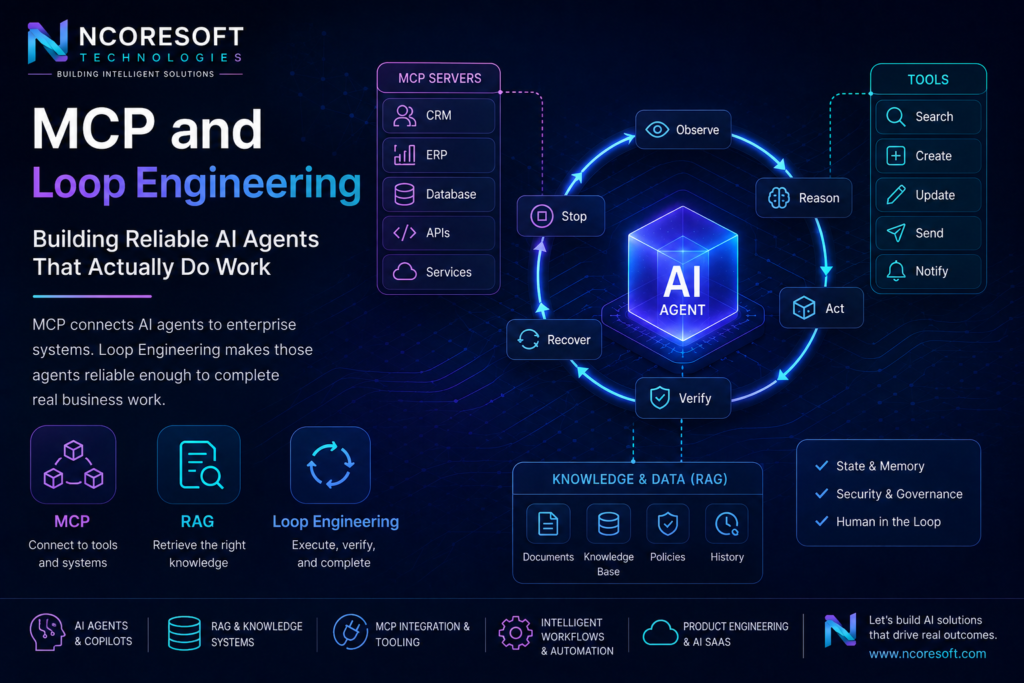
MCP connects AI agents to enterprise systems. Loop Engineering makes those agents reliable enough to actually complete work.
AI is moving beyond chatbots.
The first generation of enterprise AI focused on answering questions. Then came RAG (Retrieval-Augmented Generation), allowing AI applications to reason over private company data, documents and knowledge bases.
Now the next challenge is emerging:
How do we make AI agents actually perform multi-step business work?
An enterprise AI agent may need to read a document, retrieve customer information, query an ERP, make a decision, update a record, verify the result and escalate an exception.
That requires more than an LLM.
It requires knowledge, tools, orchestration, state, verification and controlled execution.
Two concepts are becoming particularly important:
- Model Context Protocol (MCP) – a standardized way for AI applications to connect with external tools, resources and systems.
- Loop Engineering – an emerging approach to designing the execution loop that allows AI agents to observe, act, verify, recover and continue toward a goal.
At Ncoresoft, we see these as complementary parts of the next generation of enterprise AI architecture.
What Is MCP?
Model Context Protocol (MCP) is an open protocol for connecting AI applications with external data sources and tools.
Instead of creating a custom integration between every AI application and every enterprise system, MCP provides a common protocol through which AI applications can interact with capabilities exposed by MCP servers.
A simplified architecture looks like this:
                AI Application
                      │
                  MCP Client
                      │
                MCP Protocol
                      │
        ┌─────────────┼─────────────┐
        ▼             ▼             ▼
    MCP Server    MCP Server    MCP Server
        │             │             │
       CRM           ERP        Database
The important idea is standardization.
An AI agent can discover available capabilities and invoke tools without needing every application integration to be designed from scratch.
The official MCP specification describes the protocol as a standardized way for LLM applications to integrate with external data sources and tools.
Why MCP Matters for Enterprise AI
The biggest challenge in enterprise AI is often not the model.
It is access to the enterprise environment.
A typical organization might have:
- CRM systems
- ERP systems
- SQL databases
- Document repositories
- Internal APIs
- SaaS applications
- Knowledge bases
- Legacy applications
- Cloud services
- Business workflow platforms
An AI agent becomes considerably more useful when it can interact with these systems.
For example, an insurance agent could:
- Find a customer.
- Retrieve the relevant policy.
- Read submitted documents.
- Check claim history.
- Apply business rules.
- Create a claim record.
- Notify an employee.
MCP can provide the connectivity layer required for these actions.
But there is an important distinction:
MCP gives an AI agent access to tools. It does not tell the agent how to complete the job reliably.
That is where agent architecture becomes important.
MCP Is Not an AI Agent
MCP, RAG and AI agents solve different problems.
| Technology | Primary role |
|---|---|
| LLM | Reasoning and generation |
| RAG | Access to relevant enterprise knowledge |
| MCP | Access to tools, resources and systems |
| AI Agent | Planning and decision-making |
| Loop Engineering | Execution, verification and recovery |
This distinction is easy to overlook.
Connecting an LLM to 20 enterprise tools does not automatically create a reliable autonomous system.
You have solved the connectivity problem.
You still need to solve the execution problem.
What Is Loop Engineering?
Loop Engineering is an emerging approach to designing agentic workflows where an AI system can iteratively observe, reason, act, evaluate the result and continue toward a defined objective.
IBM describes loop engineering as the practice of designing agentic workflows that iteratively guide AI agents toward user-defined goals with minimal human intervention.
The important shift is from designing only the prompt to designing the loop around the model.
Consider an AI coding agent asked to:
“Fix the authentication bug.”
A simple implementation might generate a code change.
A production-oriented agent should instead operate more like this:
Understand problem
       ↓
Inspect code
       ↓
Plan change
       ↓
Modify code
       ↓
Build
       ↓
Run tests
       ↓
Inspect results
       ↓
Fix failures
       ↓
Test again
       ↓
Verify
       ↓
Complete
The intelligence is not only in the model.
It is in the system that determines what happens after the model responds.
Prompt Engineering vs. Loop Engineering
This is one of the biggest changes happening in AI development.
Prompt Engineering asks:
What should we tell the model?
Loop Engineering asks:
What should the system do after the model responds?
That second question introduces engineering requirements such as:
- What context should be retrieved?
- Which tool should be called?
- What state should be retained?
- How do we verify an action?
- What happens when a tool fails?
- Should the agent retry?
- Should it choose another approach?
- When should a human intervene?
- How many iterations are allowed?
- What evidence is required before declaring success?
This is why building production AI agents increasingly resembles systems engineering rather than prompt engineering.
The Core Components of a Reliable AI Agent Loop
A useful agentic system typically contains several layers.
1. A Clear Goal
An agent needs a measurable outcome.
Compare:
“Analyze this invoice.”
with:
“Verify this invoice against the purchase order, identify discrepancies and route exceptions for approval.”
The second defines a workflow outcome.
2. Context and Knowledge
The agent needs the right information to make decisions.
This is where RAG becomes valuable.
It can retrieve:
- Contracts
- Policies
- Customer records
- Product documentation
- Historical transactions
- Internal procedures
Ncoresoft has already applied this architecture in AI product recommendation, where RAG and AI-agent workflows retrieve information from technical documents and use it to generate explainable recommendations.
Internal link: AI Product Recommendation System Using RAG
3. Tools
An agent needs the ability to interact with the outside world.
Examples include:
searchCustomer()
getInvoice()
getPurchaseOrder()
queryDatabase()
createTicket()
updateClaim()
sendNotification()
MCP provides a standardized mechanism for exposing and discovering these types of capabilities.
4. State and Memory
Multi-step tasks require the system to remember what has already happened.
State may include:
- Previous tool calls
- Tool results
- Decisions
- Errors
- Files modified
- Tests performed
- Pending actions
- User approvals
Without state, agents can repeat work, lose context or make inconsistent decisions.
5. Verification
This may be the most important part of reliable agent engineering.
An agent should not assume:
“The tool returned successfully, so the business task succeeded.”
It should verify.
For example:
Update customer record
       ↓
Read updated record
       ↓
Validate fields
       ↓
Check business rules
       ↓
Confirm success
For software:
Write code
   ↓
Build
   ↓
Run tests
   ↓
Inspect failures
   ↓
Fix
   ↓
Test again
AI-generated action is not the same as verified outcome.
That distinction becomes critical when agents are allowed to modify real enterprise data.
6. Recovery and Retry
Enterprise systems fail.
APIs timeout.
Databases reject requests.
Documents are incomplete.
Models select incorrect tools.
A reliable loop needs to understand different types of failure.
Temporary failure
API timeout
→ retry
Recoverable failure
Tool unavailable
→ use alternative tool
Business exception
Policy violation
→ escalate
High-risk action
Financial transaction
→ human approval
The objective is not maximum autonomy.
It is controlled autonomy.
7. Stop Conditions
Every autonomous loop needs explicit stopping conditions.
An agent may stop when:
- The goal is successfully completed
- Maximum iterations are reached
- Required information is unavailable
- Confidence falls below a threshold
- A security policy is triggered
- A budget or execution limit is reached
- Human approval is required
Without stop conditions, an autonomous system can become an uncontrolled loop.
MCP + RAG + Loop Engineering
This is where the architecture becomes particularly powerful.
Think of the three technologies this way:
RAG
What does the agent need to know?
MCP
What can the agent access and do?
Loop Engineering
How does the agent complete the task reliably?
Together:
                 BUSINESS GOAL
                       │
                       ▼
                   AI AGENT
                       │
            ┌──────────┴──────────┐
            │                     │
           RAG                   Memory
            │                     │
            └──────────┬──────────┘
                       │
                    Reason
                       │
                       ▼
                      MCP
                       │
        ┌──────────────┼──────────────┐
        ▼              ▼              ▼
       CRM            ERP          Database
        │              │              │
        └──────────────┼──────────────┘
                       │
                       ▼
                     Act
                       │
                       ▼
                  Verify Result
                       │
                ┌──────┴──────┐
                ▼             ▼
             Success        Failure
                │             │
                ▼             ▼
               Done        Recover
                              │
                              └──→ Loop
This is the architectural pattern we believe will become increasingly important for enterprise AI.
A Practical Example: AI-Powered Document Workflow
Consider an enterprise processing thousands of invoices.
A traditional document AI application might:
- Read the invoice.
- Extract fields.
- Store the data.
- Ask an employee to review it.
An agentic workflow can go much further.
Step 1 – Extract
AI identifies invoice information.
Step 2 – Retrieve
RAG retrieves the relevant contract and purchase order.
Step 3 – Connect
MCP tools query the ERP and vendor systems.
Step 4 – Reason
The agent compares the invoice with the purchase order and business rules.
Step 5 – Act
It updates the appropriate system or creates an exception.
Step 6 – Verify
It confirms that the change actually occurred.
Step 7 – Recover
If an integration fails, it retries or escalates.
Step 8 – Complete
The system records the final state and audit trail.
The difference is significant.
The AI is no longer simply extracting information.
It is participating in an end-to-end business process.
Why Security and Governance Matter
The moment an AI agent can perform actions, security requirements change.
The question is no longer simply:
“What information can the AI read?”
It becomes:
“What is the AI allowed to do?”
Production systems should therefore consider:
- Least-privilege access
- Authentication and authorization
- Read/write separation
- Human approval for high-risk actions
- Tool-level permissions
- Audit logging
- Rate limits
- Data isolation
- Execution budgets
- Explicit stop conditions
The latest MCP specification, released July 28, 2026, includes a stateless protocol core, routing improvements, cacheable list results, authorization hardening, Tasks and an extensions framework changes that are particularly relevant as MCP moves toward larger production deployments.
The Ncoresoft Point of View
At Ncoresoft, we don’t see enterprise AI as simply:
LLM + chatbot = AI application.
We see it as a systems problem.
A production AI application may require:
LLM + RAG + tools + MCP + agent orchestration + state + verification + security + human control.
Our experience building SaaS products, enterprise applications and AI systems shapes how we approach this.
The model is only one component.
The competitive advantage comes from engineering everything around it.
Our recent AI work includes RAG-powered product recommendation and AI-agent workflows that combine document retrieval, reasoning and explainable recommendations.
We also work across modern .NET, cloud and product-engineering environments, allowing AI capabilities to be introduced into existing software rather than forcing businesses to replace their entire technology stack.
Internal links:
The Future of AI Is Not Just Better Answers
The next generation of enterprise AI will increasingly be judged by a different metric.
Not:
How good was the response?
But:
Did the system successfully complete the job?
That requires a shift in how we build AI applications.
RAG gives agents knowledge.
MCP gives agents access to tools and systems.
Loop Engineering gives agents a mechanism for continuous execution and verification.
Together, they move AI from a conversational interface toward an operational layer for enterprise software.
At Ncoresoft, we believe the opportunity is not simply to make existing applications smarter.
It is to make them capable of understanding, deciding, acting, verifying and improving workflows.
That is where enterprise AI becomes more than a chatbot.
That is where AI starts doing real work.
Frequently Asked Questions
What is MCP in AI?
Model Context Protocol (MCP) is an open protocol that standardizes how AI applications connect with external tools, resources and data sources. It helps AI systems interact with enterprise capabilities through a consistent interface.
What is Loop Engineering?
Loop Engineering is an emerging approach to designing AI-agent workflows around iterative execution. The agent can observe information, reason, act, evaluate results, recover from failures and continue toward a defined goal.
Is MCP the same as an AI agent?
No. MCP provides a connectivity and interoperability layer. An AI agent uses tools exposed through systems such as MCP as part of a larger reasoning and execution architecture.
What is the difference between RAG and MCP?
RAG helps an AI system retrieve relevant external knowledge. MCP helps an AI application access tools, resources and systems. An enterprise agent can use both.
Is MCP replacing APIs?
No. Existing APIs can continue to power enterprise systems. MCP can provide a standardized interface through which AI applications interact with those capabilities.
Why does Loop Engineering matter?
As AI agents perform longer and more complex tasks, the first model response is not enough. Agents need state, verification, retries, recovery mechanisms and clear stopping conditions to operate reliably.
Should businesses use MCP for every AI application?
No. MCP is most valuable when AI applications need reusable, standardized access to multiple tools, resources or enterprise systems.
Can Ncoresoft build MCP and AI-agent solutions?
Yes. Ncoresoft can design and build AI agents, RAG systems, MCP integrations, AI document-intelligence workflows and AI-powered SaaS applications around existing enterprise systems.
Build AI That Actually Does the Work
If your organization is exploring AI agents, MCP, RAG or intelligent workflow automation, start with the business process, not the model.
Identify a workflow where AI can reduce manual effort, accelerate decisions or connect fragmented systems.
Then engineer the architecture around it.
Ncoresoft builds AI-powered software systems that connect enterprise data, applications and workflows with modern AI.
Talk to Ncoresoft about your AI agent or intelligent workflow project.
