

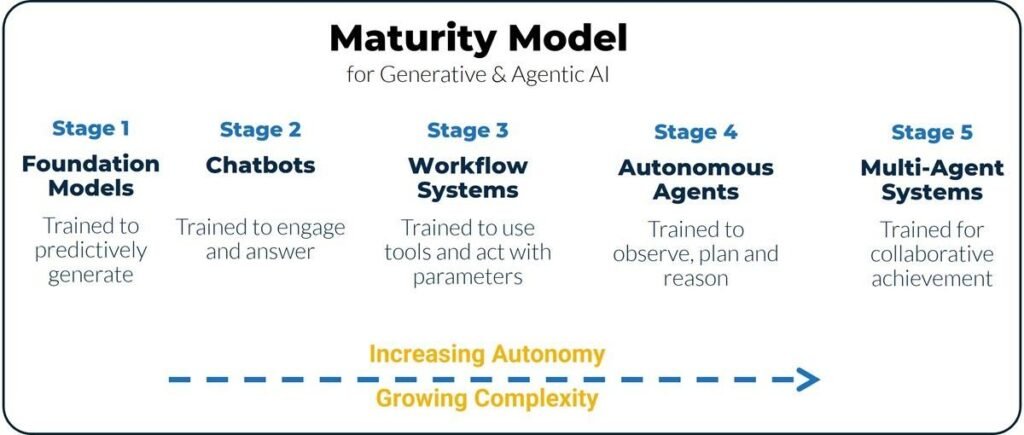
Last year, adding “AI-powered” to your product felt like an upgrade.
This year, it’s starting to look like a liability. Because something subtle but important has changed.
Companies that rushed to “add AI” are now realizing:
- Their costs went up
- Their workflows didn’t improve
- And their teams are still doing the same work
Just with slightly better tools.
The Illusion of Progress
Right now, there are thousands of companies proudly showcasing:
- AI chatbots
- Smart recommendations
- Automated responses
On the surface, it looks like innovation.
But when you look closely, most of these systems are doing one thing:
They are assisting humans – not replacing effort.
And that’s the problem.
The Shift Nobody Is Talking About
The real shift in AI isn’t about better models or faster responses.
It’s about this one question:
“Can this system take ownership of a task?”
Not help.
Not assist.
Own.
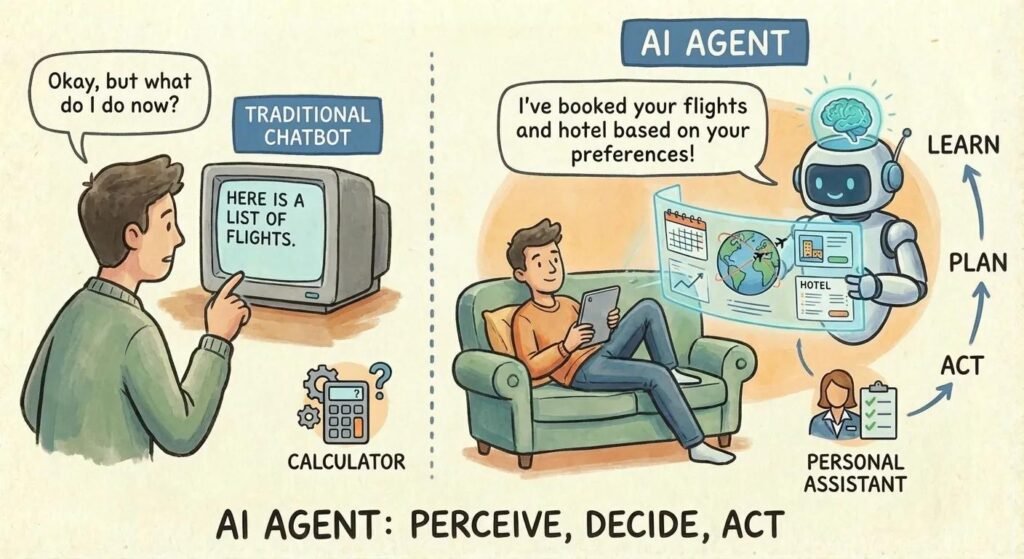
Let’s break that down.
There are three stages of AI adoption:
1. Tool Phase (Where most companies still are)
- AI helps you write
- AI helps you analyze
- AI helps you respond
=> Outcome: Slight efficiency boost
2. Teammate Phase (Where things get interesting)
- AI suggests decisions
- AI automates parts of workflows
=> Outcome: Noticeable productivity gain
3. Ownership Phase (Where the winners are going)
- AI executes tasks end-to-end
- AI makes decisions within defined boundaries
- AI replaces entire workflows
=> Outcome: Exponential output
Most companies are stuck in Phase 1 and celebrating it.
A Simple Reality Check
If your AI system still requires:
- Constant human prompting
- Manual validation at every step
- Human execution after AI suggestions
Then you don’t have an AI system.
You have a better UI for existing work.
What Leading Companies Are Doing Differently
Instead of asking:
“Where can we use AI?”
They are asking:
“What work should exist at all?”
This leads to completely different solutions.
Example: Customer Support
Traditional AI approach:
- Chatbot answers FAQs
- Escalates complex queries
Result:
=> Support load reduces slightly
New approach:
- AI agent resolves tickets
- Processes refunds
- Updates systems
- Communicates with customers
Result:
=> 60–80% of support handled without human involvement
That’s not optimization.
That’s replacement of effort.
Why This Matters More in the US Market
In markets like the US, the pressure is not on innovation alone.
It’s on:
- Reducing operational cost
- Increasing output per employee
- Scaling without increasing headcount
That’s why AI adoption there is moving faster towards ownership models.
Where Most Businesses Go Wrong
After working with multiple teams, a pattern is clear.
Most AI initiatives fail because they start like this:
“Let’s build something with AI.”
Instead of:
“Let’s remove this problem completely.”
This leads to:
- Overbuilt systems
- Low adoption
- Poor ROI
And eventually:
“AI didn’t work for us.”
The Rise of AI Agents (And Why They Matter)
The next wave of AI is not tools.
It’s agents.
Systems that:
- Understand context
- Take actions
- Deliver outcomes
Without waiting for instructions at every step.
Think of it this way:
Old software:
=> You click buttons to make things happen
New AI systems:
=> Things happen because the system knows what needs to be done
What This Means for Businesses
This shift is going to redefine how companies operate.
- Smaller teams will handle larger workloads
- Decision cycles will shrink
- Execution will become faster and more consistent
And most importantly:
Companies that adopt this early will operate at a completely different efficiency level.
The Opportunity for Indian Companies
There is a massive opportunity here.
Because while many Indian companies are still:
- Selling development
- Building features
- Delivering integrations
Global buyers are looking for:
- Outcomes
- Automation
- Business impact
This gap creates a powerful positioning:
=> If you can deliver outcome-driven AI systems,
you are not competing on cost anymore.
You are competing on value.
A Better Way to Approach AI
If you’re building or adopting AI, here’s a more effective framework:
1. Identify friction, not features
Look for:
- Delays
- Repetition
- Human dependency
2. Redesign the workflow
Don’t insert AI into existing processes.
Rebuild the process assuming:
AI is doing the work.
3. Define ownership
Ask:
- What part can AI fully own?
- Where is human input truly required?
4. Measure outcomes
Track:
- Time saved
- Cost reduced
- Output increased
5. Iterate fast
AI systems improve with usage.
The faster you deploy, the faster you learn.
The Bottom Line
AI is no longer about doing things better.
It’s about deciding:
what should be done at all.
The companies that win won’t be the ones with the most advanced models.
They’ll be the ones who asked better questions.
So before you build your next AI feature, pause for a moment and ask:
“If we were starting from scratch today, would this work even exist?”
Because in many cases, the most powerful use of AI is not improving work.
It’s eliminating it entirely.